
A Pressure That Has Started, But Not Yet Landed
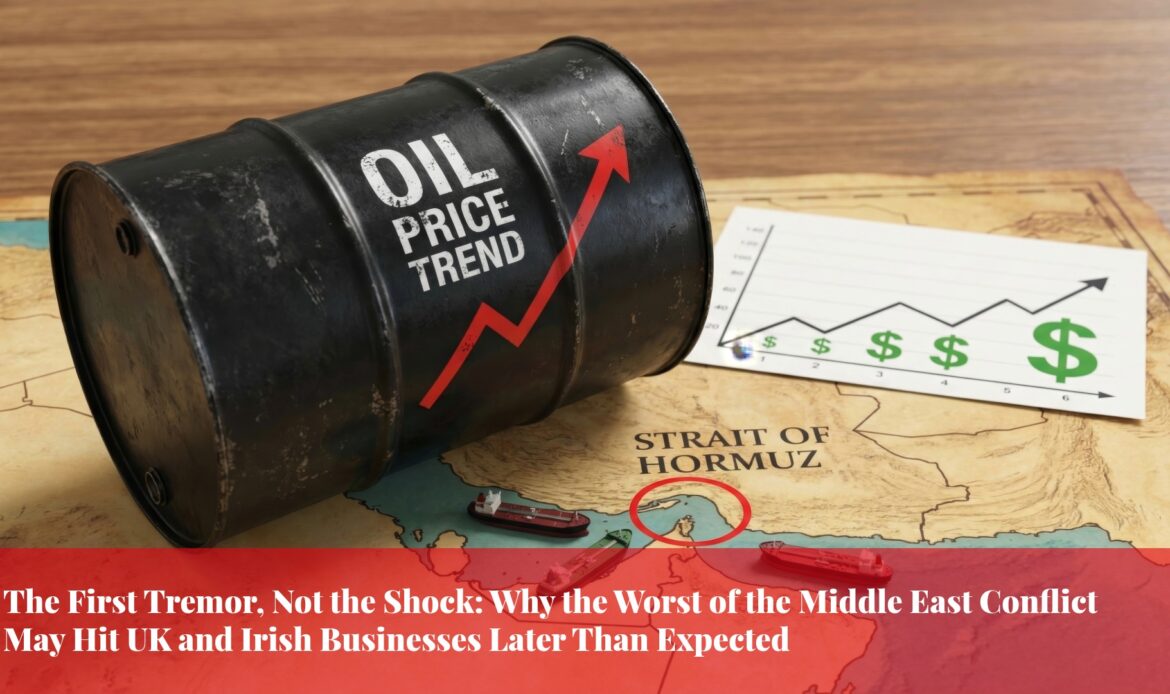
There is a tendency in business to react to events when they become visible. When prices spike, when orders fall away, when costs land on the P&L in black and white. The difficulty with the current conflict in the Middle East is that the impact is already here, but it hasn’t fully arrived. What we are seeing now looks less like a shock and more like the first tremor — subtle enough to ignore, but significant enough to matter.
The Institute of Directors has already warned that the conflict is beginning to show up in inflation data, particularly through transport costs. Oil prices have moved sharply, and the ripple effect into logistics, distribution and energy-intensive sectors is now underway. The British Chambers of Commerce has echoed that sentiment, describing business confidence as fragile even before the latest escalation. That matters, because fragile economies do not absorb shocks well. They amplify them.
The real question, therefore, is not whether this conflict will affect businesses across the UK and Ireland. It already is. The more important question is whether we are underestimating the lag — and whether the real impact is still to come.
Where the Economic Pressure Will Be Felt First
Some sectors are immediately exposed. Manufacturing, engineering, logistics, food production, construction materials and hospitality all sit close to the front line of energy and transport costs. These are industries where margins are already tight, where pricing power is often limited, and where input cost increases are difficult to pass through quickly.
Transport is the most direct transmission mechanism. Rising fuel costs feed into haulage, distribution and supply chains, creating pressure that is operational rather than theoretical. For firms trading between the UK and Ireland, that pressure intensifies due to geography. As an island economy, Ireland remains more exposed to fuel, freight and aviation volatility, meaning that cost increases are felt sooner and often more sharply.
The deeper vulnerability, however, is structural. The businesses most at risk are those operating with limited financial headroom, thin margins and constrained access to capital. Smaller manufacturers, subcontract engineering firms, hauliers, food producers and owner-managed businesses fall into this category. Many have already absorbed rising wage costs, higher borrowing costs and persistent inflation. They are not entering this period from a position of strength.
The Federation of Small Businesses has been clear that cost pressures were already widespread before this latest development. When an external shock lands on top of that, it does not create a new problem. It compounds an existing one.
Why This Phase Is More Dangerous Than It Looks
It would be easy to frame this as another energy-driven disruption, similar to previous shocks. That would miss the point. The context is what makes this moment more dangerous. Businesses are already operating in an environment characterised by weak growth, low investment and cautious hiring. Confidence is not robust; it is tentative. The British
Chambers of Commerce has highlighted that many firms are already delaying decisions because of uncertainty. That uncertainty now has another layer.
A strong economy can absorb a shock and recover quickly. A fatigued economy absorbs it slowly and recovers even more slowly. The risk is not an immediate collapse, but a gradual tightening. Costs rise. Investment pauses. Hiring slows. Margins compress. Over time, that becomes stagnation.
This is why focusing on Q4 2026 is entirely reasonable. The effects of higher energy and transport costs do not fully materialise immediately. They move through contracts, supply chains and pricing cycles. What feels manageable today can become restrictive several months from now.
The Hidden Impact: Investment Gets Squeezed Out
One of the least visible consequences of rising costs is what they displace. When businesses allocate more capital to energy, transport and immediate operational pressures, they have less available for long-term investment.
Ibec has already warned that high energy costs are crowding out investment in sustainability, infrastructure and expansion. This is not a short-term inconvenience. It is a structural constraint. When investment is delayed, growth is delayed. When that pattern repeats across sectors, the wider economy slows. This is how external shocks evolve into prolonged stagnation. Not because the shock itself is overwhelming, but because it changes behaviour.
The Human Cost: The Pressure Inside the Business
What often gets overlooked in discussions like this is the human dimension — and it is here that the real pressure is already being felt. For many employees, the strain has been building for some time. Wage increases have not kept pace with inflation. Mortgage costs have risen. Rent has increased. Food bills remain elevated. Energy costs are still materially higher than they were. Now add another layer of upward pressure, and the reality becomes clear.
Employees are not reacting to a single event. They are living through sustained financial pressure with no clear endpoint. That pressure shows up in ways that do not appear in management accounts. It shows up in distraction, fatigue and reduced focus. It shows up in people worrying about personal finances while trying to maintain performance. Over time, it shows up in absence, presenteeism and burnout.
The Institute of Directors has consistently framed employee wellbeing as a leadership issue. In this environment, that is not optional thinking. It is operational reality. If people are stretched financially and mentally, performance follows. Teams slow down. Mistakes increase. Engagement drops. Culture shifts gradually in a way that is difficult to reverse.
Leadership Under Sustained Pressure
What separates stronger organisations is not just financial resilience, but how leadership responds to this internal reality. Acknowledgement matters. Employees do not expect solutions to global issues, but they do expect honesty. When leadership messaging suggests stability while individuals are experiencing strain, trust erodes. Communication becomes critical. People handle pressure better when they understand what is happening
and how the business is responding. Silence creates uncertainty, and uncertainty rarely resolves positively.
Practical support also matters. This does not require excessive cost, but it does require intent. Flexibility, prioritisation of work, and access to support can make a tangible difference. There is also a discipline required around workload. Increasing pressure internally while employees are already dealing with external stress is not sustainable. It may deliver short-term output, but it reduces long-term capability.
The Risk Leaders May Be Missing
The connection between financial strain and organisational performance is often underestimated because it is treated as a social issue rather than an operational one. In reality, they are closely linked.
An employee under sustained financial pressure is less able to focus, less likely to take initiative, and more inclined to prioritise short-term stability over long-term contribution. When that dynamic exists across a workforce, the impact becomes measurable. In sectors already facing operational strain, this compounds quickly. The same businesses dealing with rising costs externally are managing reduced resilience internally, even if it is not immediately visible.
The Reality Facing Businesses Now
The current environment does not point to immediate crisis. It points to something more gradual and more challenging — a tightening of conditions that erodes confidence, constrains investment and tests resilience over time.
The first tremor has already been felt. Costs are moving. Sentiment is cautious. The real test may come later — not in headlines, but in decisions quietly deferred, projects quietly cancelled, and pressure that builds steadily until it can no longer be ignored.
The Leadership Decision
For leaders, the choice is straightforward. Wait for the impact to become visible or prepare for the pressure before it fully arrives. Because the real risk is not simply that costs rise further. It is that the people expected to carry the business through that period are already stretched further than anyone fully appreciates.
The difference between reacting late and preparing early will not just define performance. It may define survival.