
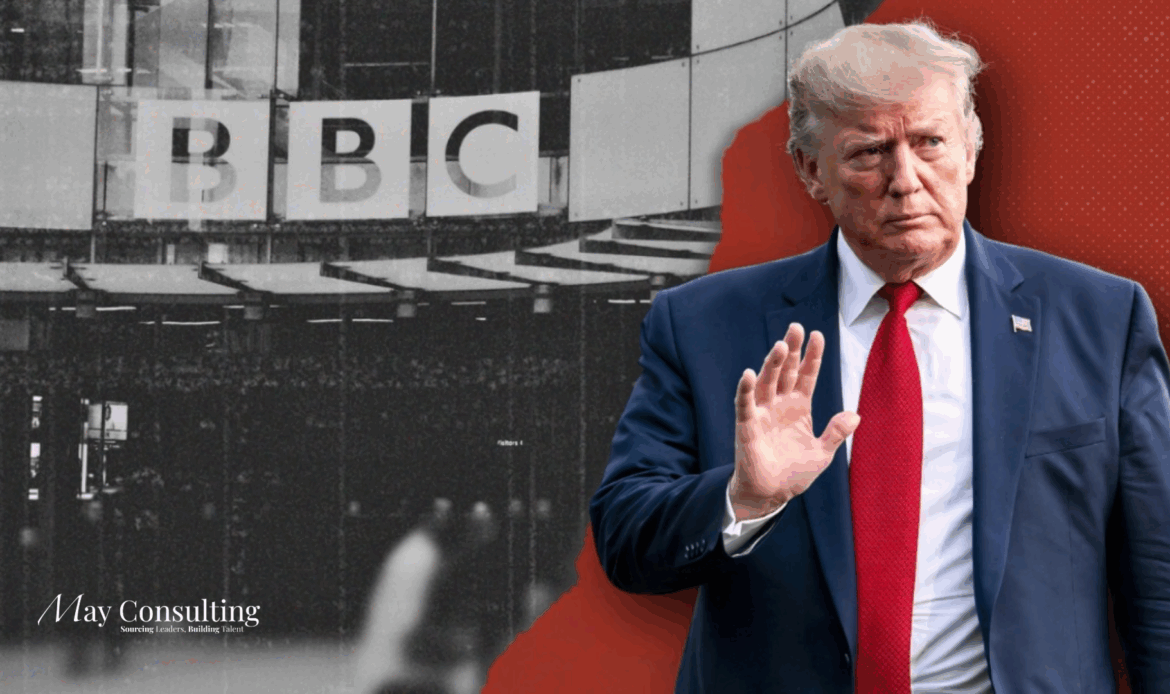
There are moments when the concept of truth itself becomes a headline. The recent clash between Donald Trump and the BBC over an edited Panorama interview is one of those moments — a powerful man accusing a powerful institution of distortion, and a broadcaster defending its editorial choices in the glare of global scrutiny. It’s a story about perception, editing, and trust: who controls the narrative, and who pays the price when that narrative is bent out of shape.
The details of that dispute may belong to politics and media, but the underlying dynamic plays out every day in boardrooms, interview panels and CVs across the UK and Ireland. When people adjust, exaggerate or airbrush the truth to suit their story, the fallout rarely stays contained. In journalism, it’s the producer or editor who gets pushed out. In business, its often colleagues, line managers, or an entire HR department left cleaning up the mess.
The temptation to “edit” one’s story is as old as ambition. A stronger title here, a larger budget there, a degree that sounds grander than it was — these are the professional equivalents of the cut-and-splice edit. They’re small acts of distortion dressed as self-presentation, justified as harmless or strategic. But as the Trump–BBC row reminds us, once truth is contested, everyone inside the frame gets burned.
The psychology of embellishment
Every recruiter has seen it: a CV that reads just a little too well, a timeline that’s a little too tidy. The person who “led” a project rather than supported it, who “transformed” a division rather than contributed to an improvement, who “held” a qualification rather than studied part of one. Most of these tweaks start innocently enough. The candidate tells themselves that it’s only marketing. But marketing becomes misrepresentation the moment someone else acts on it.
According to the CIPD’s 2024 research on employment integrity, almost one in ten UK workers admit to having misrepresented their role or qualifications when applying for a job, while more than a quarter believe others in their industry do so routinely. Employers, meanwhile, estimate that a bad hire caused by false information costs them an average of £18,000 in recruitment, training, and lost productivity. The CIPD’s own Code of Professional Conduct defines integrity as “being truthful, honest and transparent in all professional dealings.” The definition is unambiguous because the damage caused by dishonesty spreads far beyond the person who commits it.
The collateral damage
When a high-profile figure fabricates a credential or inflates their record, the focus tends to stay on them — the fall from grace, the apology, the resignation. But as with the BBC saga, the wider damage is often borne by others. The producers who edited the segment now face accusations that may follow them for years. In a corporate context, it’s the HR team or the line manager who is blamed for not vetting properly, the colleague passed over for promotion because someone else’s embellished story looked stronger, or the employer whose reputation for diligence is suddenly in question.
The IoD’s own guidance on directorship is blunt: integrity is the first of its seven core principles. “A director should act honestly, in good faith, and with transparency in their dealings,” it says. Breaches of that principle, even when not criminal, erode the foundation of governance. When a senior appointment collapses under the weight of misrepresentation, it doesn’t just cost money; it corrodes the confidence of investors, staff, and regulators alike.
Consider the case of former NHS executive Antonia Phillips, who in 2023 was found to have fabricated elements of her academic record, leading to resignation and a full review of the recruitment process that appointed her. Or the financial services director who claimed a professional chartership he never earned; the discovery cost him his job and triggered regulatory scrutiny of the firm’s entire verification system. In both instances, the deception’s ripple effect reached well beyond the individual.
The legal dimension
In the UK, lying on a CV is not merely unethical — it can be a criminal offence. The Fraud Act 2006 makes it illegal to make false representations for personal gain, and several people have been prosecuted for claiming degrees or experience they did not have. The best-known case remains that of Lee Hendrie, the executive who fabricated academic qualifications and served jail time for fraud by false representation. Employment law also recognises misrepresentation as grounds for dismissal without notice.
ACAS advises employers to take a “proportionate but firm” stance: verification and due diligence are not about suspicion but about protecting the integrity of the process. It’s a point many businesses still overlook. In the rush to fill vacancies, checks are delegated, qualifications assumed, and references rubber-stamped. The result is preventable risk — not just legal exposure, but operational vulnerability when an unqualified person occupies a critical role.
Cultural contagion
Integrity is cultural before it is procedural. When organisations tacitly reward exaggeration — when leaders are allowed to round up their achievements or employees learn that spin is safer than honesty — the rot sets in quietly. The next person copies the behaviour, the next manager overlooks it, and soon the organisation has normalised the very thing it claims to guard against.
CIPD research on organisational trust notes that “employees take behavioural cues from the top.” If senior managers are seen to embellish results, understate mistakes, or inflate titles, the message is unmistakable: accuracy is optional. Conversely, when leaders are candid about their own limits and errors, they create psychological safety for honesty to flourish.
This cultural contagion is why embellishment can’t be treated as an individual moral failing alone. It’s systemic. The HR function can enforce checks and balances, but culture decides whether people feel compelled to distort in the first place.
The ethics of ambition
There is, of course, a grey zone. Everyone presents themselves in the best possible light; few candidates list their failures on a CV. The distinction between framing and falsifying often lies in intent. The IoD describes ethical leadership as “doing the right thing when no one is watching.” In recruitment, that means representing achievements as they were, not as they might sound in a bolder retelling.
The professional world is built on small acts of trust: the belief that a qualification is genuine, that experience claimed was actually held, that numbers in a report mean what they say. Break that chain often enough and cynicism sets in. The same cynicism now dogs public discourse — the sense that every statement is an angle, every edit an agenda. The Trump–BBC dispute is only the loudest current example of a much larger phenomenon: truth becoming negotiable.
The hidden victims
When a fabrication collapses, others almost always suffer. Colleagues who vouched for the person face embarrassment. Mentors who provided references question their judgement. Teams that depended on the individual’s competence are left to rebuild credibility with clients or regulators. In some cases, people genuinely lose their jobs.
One HR director I spoke to for this piece recalled an incident where a newly appointed head of operations was discovered to have falsified a degree and employment history. “It wasn’t just his dismissal,” she said. “Two senior managers who’d endorsed his application felt compelled to resign because they believed they’d failed in due diligence. It wiped out months of stability.”
The analogy to media is clear: when an edit, omission or embellishment goes wrong, it’s rarely the editor alone who pays the price. The institution’s integrity becomes the collateral damage.
Reputation and redemption
Reputational recovery after deceit is brutally difficult. The CIPD has written extensively about the link between integrity and employability: honesty, once lost, is a slower rebuild than any skill. Some people never recover their careers; others spend years explaining a single poor decision. In the digital age, where CVs live online and background-check software cross-verifies employment data, the possibility of “starting over” is shrinking fast.
Yet redemption is possible, and organisations that handle breaches well can strengthen their culture through transparency. The key, according to the Chartered Institute of Personnel and Development’s ethics forum, is proportionate response. Not every inconsistency is fraud; sometimes it’s misunderstanding. But where deception is deliberate, clarity matters more than compassion. Quietly letting someone “resign to pursue other interests” is itself a form of concealment — another small lie that corrodes trust.
The recruiter’s dilemma
For executive search firms, background verification can feel like the unglamorous side of the job. But it is the bedrock of credibility. At senior levels, the consequences of negligence are amplified. A board appointment that unravels under scrutiny can damage a client’s reputation and a search firm’s brand overnight. The IoD’s guidance to nomination committees is explicit: “Verification of credentials and experience should be independent, documented, and ongoing.”
Technology helps — digital credentialing, LinkedIn cross-validation, AI-driven screening — but tools only work if culture demands their use. The professional recruiter’s value is not only in finding exceptional talent but in safeguarding integrity on behalf of the client.
The leadership lens
What, then, should leaders take from all this? First, that integrity is not a compliance box; it’s an operational advantage. Teams function faster when they trust the data, the person, and the process. Second, that small distortions compound. The line between self-promotion and deceit is crossed long before the lie is discovered; it’s crossed the moment someone feels entitled to reshape reality for effect.
And finally, that the currency of credibility has never been more volatile. In an era of AI-generated content, deepfakes and instant amplification, truth travels slower than fiction but lasts longer. The leaders who will endure are those who can anchor their organisations in verifiable, demonstrable honesty — who understand that reputation is not built by PR but by proof.
The wider reflection
The Trump/BBC row may seem worlds apart from recruitment ethics, yet the mechanics are identical. A story is told, edited, defended; another party claims distortion; the public loses faith in both. Each side insists it acted in good faith. Each insists the other bent reality. What remains is noise — and noise is where trust goes to die.
In business, as in journalism, credibility is cumulative but perishable. A thousand accurate statements can be undone by one lie. When leaders or candidates embellish their histories, they may not face lawsuits worth a billion dollars, but they risk something equally valuable: the trust of the people who believed them.
The professional bodies that frame our working lives — the CIPD, the IoD, ACAS, the FCA — all orbit a single principle: integrity. It’s not a virtue reserved for saints or a slogan for HR posters. It’s the operating system of professional life. Lose it, and everything else — talent, strategy, ambition — starts to malfunction.
The embellishment trap is seductive because it promises acceleration: the shortcut to credibility, the faster route to promotion, the smoother interview. But the bill always arrives, and it’s usually paid by more than one person.
As the dust settles on yet another public battle over truth and editing, it’s worth remembering that integrity rarely collapses in one dramatic moment. It decays in increments — a line adjusted here, a date rounded there, a silence left uncorrected. The antidote isn’t grand moralising; it’s consistency. Tell the truth even when it’s less impressive. Record what happened, not what would sound better. Lead with honesty, and the rest of the narrative takes care of itself.
Because when truth becomes optional, trust becomes impossible — and once trust is gone, everything else is just noise.