
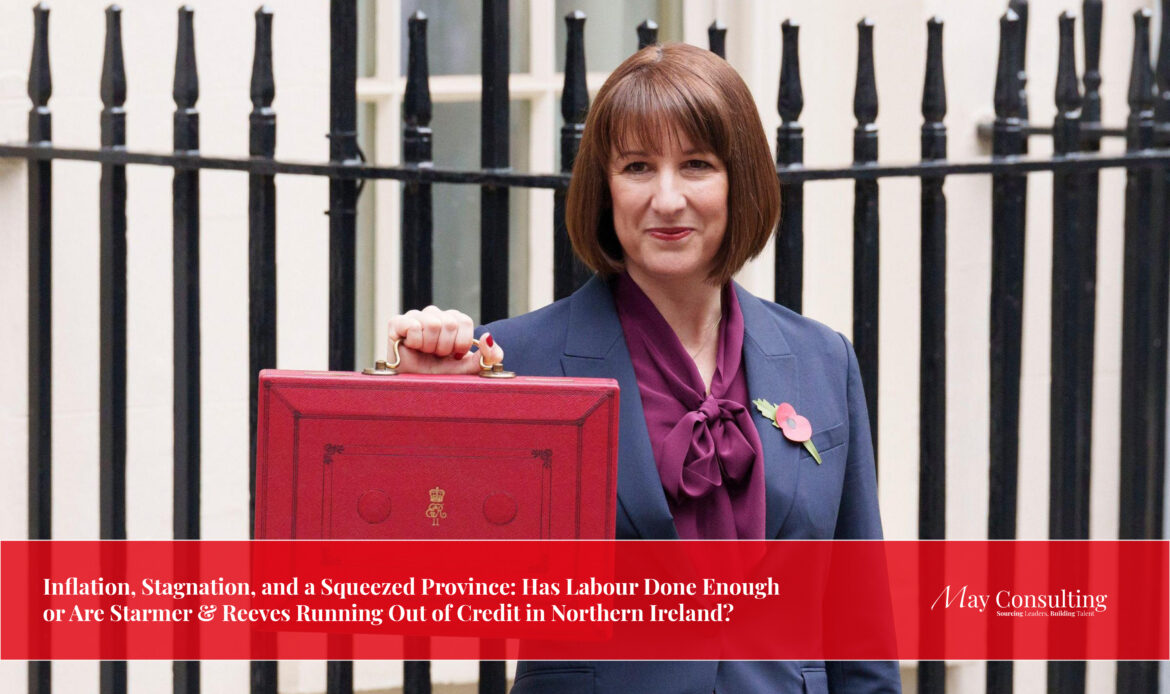
Inflation isn’t a Westminster debating point in Belfast or Ballymena; it’s the till ringing louder than it should, the utilities bill that makes the FD wince, the wage review that spirals beyond what the order book justifies. In August 2025 UK CPI held at 3.8%, the highest among the big advanced economies and nearly double the Bank of England’s target. Prices in the basket that ordinary people actually feel—food, hospitality, petrol—continue to bite, while real wage gains flatten once you adjust for inflation. Business investment hesitates; consumers flinch at checkout. In short: it’s sticky, it’s wearying, and the politics of “we’re turning a corner” feel detached from the shop floor reality.
Northern Ireland sits at the uncomfortable intersection of all of this: a region with enviable dual-market access and a sophisticated manufacturing base, but also with thin margins, higher energy sensitivity, and a succession of cost shocks that land harder on smaller balance sheets. The question isn’t whether the Labour government under Keir Starmer and Rachel Reeves has avoided obvious blunders—they largely have. The question is whether, for NI businesses in particular, the government has delivered enough to tame inflation’s drag and unlock growth. On the evidence to hand, not yet.
What the numbers are really telling us
Start with the headline: CPI at 3.8% (August 2025), with food and non-alcoholic drink inflation running around 5%, hospitality/petrol still elevated. Wages are growing c. 4.8% on basic pay, which sounds healthy until you net out inflation and higher employment costs; for many employers, that growth is a cost line, not a “feel-good” stat. Growth over the three months to July is 0.2%—a recovery that feels more like marking time. The Bank of England’s own guidance has inflation peaking near 4% in September and remaining above target well into 2026/27, limiting space for rate cuts. That’s the macro stage on which every owner in Antrim or Armagh is trying to perform.
Business groups aren’t mincing words. The British Chambers of Commerce said this morning that firms are “worried by inflation holding at 3.8%… with cost pressures continuing to bite, especially on wages,” adding that April’s NI rise, stronger pay growth and tariffs are “eroding operating margins,” and that sticky inflation will curb hopes of rate relief. The Institute of Directors has been warning all summer about “stubborn” CPI and the risk of price pressures
in categories “felt by consumers,” which is to say: the ones that keep sentiment weak. Make UK keeps highlighting persistent skills shortages and apprenticeship fragility—structural bottlenecks that keep costs elevated for manufacturers already chewing through energy and input volatility.
So much for the UK picture. What about Northern Ireland?
Northern Ireland: a squeezed middle between opportunity and cost
Northern Ireland’s pitch to investors is good: dual access to GB and EU markets, strong clusters in aerospace, packaging, agri-food, and advanced engineering, and a workforce with deep industrial pride. But inflation exposes the weak points: energy price sensitivity, logistics frictions, smaller average firm size, and harder trade-compliance overhead when you straddle two regimes. Those frictions show up in the quarterly barometers.
The NI Chamber/BDO Quarterly Economic Survey (Q1 2025) flagged negative cashflow balances across both manufacturing (-3) and services (-1), with cost pressures—labour, energy, inputs—top of the list. The message to policymakers was blunt: be “courageous” with support, because inflation and taxes are tightening the noose. By Q2, 52% of NI firms reported a slowdown in demand (up from 46%), with many delaying or cutting investment. Translation: if you were banking on a capex-led recovery, inflation has just eaten your deposit.
The labour market picture is more nuanced but hardly comforting. NISRA’s September 2025 report shows 2,430 confirmed redundancies over the year (down slightly year-on-year), 3,080 proposed redundancies (up >10%), and a claimant count of 36,200 (3.7%), still 21.3% above pre-pandemic levels. That doesn’t scream crisis, but it does signal a region stuck in a low-confidence holding pattern.
On trade, NISRA’s EU Exit Trade Analysis and the NI trade dashboards are invaluable: they document flows to GB, ROI, the wider EU and RoW, and are a reminder that compliance work hasn’t magically vanished—it’s become a permanent capability cost for firms serving both sides of the Irish Sea. Every extra hour in documentation and supply-chain assurance is an hour not spent on productivity. For large corporates that’s overhead; for NI SMEs it’s a margin killer.
Sector by sector, the story is consistent:
- Manufacturing & Advanced Engineering (from composites to precision machining) are absorbing skills shortages and energy bills while trying to invest in automation and ESG to stay in frame for GB/EU customers. Make UK’s skills commission may be UK-wide, but its diagnosis—apprenticeship reform, targeted upskilling—maps directly onto NI’s factory floor.
- Agri-food faces a double bind: elevated input costs and regulatory compliance on cross-border flows, with limited scope to pass increases to supermarket buyers without losing volume.
- Packaging and wider materials businesses are squeezed by energy, resin/paper inputs, and sustainability reporting burdens that require new leadership competencies (ESG literacy, supply-chain due diligence).
- Construction/Infrastructure in NI sees live demand but fights tender pricing set before cost spikes, creating margin risk on delivery.
None of this is fatal; all of it is draining. And inflation that refuses to sink to target keeps the drain open.
What Labour has done—and where it isn’t landing in NI
Give Starmer and Reeves their due: the Treasury has avoided the policy lurches that earned the UK a risk premium in recent years. The rhetoric is more pro-investment, the stance towards business more predictable. There are pledges on planning, grid, skills, and a nod to industrial strategy. On paper, NI ought to benefit: clarity is currency when you sell across two markets.
But here’s what NI businesses are experiencing instead:
- Pace beats posture
Measured intent is not relief. If your cashflow is negative and your energy bill is due, a white paper isn’t working capital. NI Chamber’s survey evidence—weaker demand, delayed capex—suggests the cavalry is still on the ridge, not in the town. - Employer cost stack still rising
Wages need to keep up with living costs, but the stacked effect of NI rises, pay drift and compliance is eroding margins precisely when firms might otherwise invest. That’s the BCC line in a nutshell: “cost pressures continue to bite… eroding operating margins,” and sticky inflation clips the odds of rate relief. - Energy: the unresolved pressure point
For energy-intensive NI manufacturers, volatility and pricing differentials versus GB peers remain a strategic headache. Without targeted relief or faster grid/market reforms, CFOs won’t sign off the capex that unlocks productivity. - Skills policy not matching the speed of the gap
The skills gap—especially at senior/technical levels—is the quiet tax on growth. Make UK’s proposed apprenticeship fixes help in principle; NI’s Skills Council keeps surfacing the same warning lights on inactivity and pipeline. Until delivery accelerates, wage inflation and vacancy persistence will keep the cost base hot.
Trade friction as a “forever cost”
Dual access is a genuine NI advantage, but the operational cost of straddling two regimes is not priced away by speeches. The NISRA dashboards tell you how business actually works now: more compliance, more diligence, more cost. Good firms will adapt; smaller firms will trim ambition.
So—P45s for Starmer and Reeves?
If the test is intent, they pass. If the test is delivery felt by firms in Northern Ireland, they’re not there yet. The inflation line is too high for too long; wage and compliance costs are chewing through resilience; investment appetites are cooling in the very sectors that anchor NI’s export story. The longer CPI hangs around ~4% while the Bank signals a slow glidepath back to target, the more you should expect capex to slip, employers to tread water on headcount, and management teams to defer risk.
Should the Labour faithful sack them on today’s evidence? No—but I would serve a written warning on delivery for the regions that carry UK industry. If we’re still here by mid-2026—inflation near 4%, NI investment soft, claimant count elevated, and no visible easing of the employer cost stack—then yes, the political calculus will tilt towards fresh hands on the economic tiller.
What “enough” would look like—specifically for NI
Here’s a programme that would move the needle where our clients live:
- Energy cost realism for NI industry. A time-limited relief or rebate for energy-intensive users, fast-track grid connections for electrification and on-site renewables, and a predictable path on charges. That’s how you unblock factory-floor automation without blowing up the P&L.
- Targeted employer-cost offsets. If national insurance and wage floors are moving up, give compensating relief to NI SMEs tied to investment (capex, training) or export growth. The BCC is right: the current cost mix is eroding margins; rebalance it where the pound of investment does the most good.
- Skills with a stopwatch. Lift the best of Make UK’s apprenticeship reforms and localise them: rapid approvals, simplified funding routes, employer-led standards in advanced manufacturing, net-zero supply chains, and digital production. Fund mid-career upskilling so we don’t lose experienced operators to the wage spiral.
- Leadership pipeline as infrastructure. Treat board and senior leadership development as a growth enabler, not a private concern. Co-fund cross-border secondments, and reward firms that evidence succession plans. When leadership is scarce, productivity plans die in meetings.
- Trade friction minimisation as a service. Expand one-stop compliance support for SMEs trading GB/EU—shared services for documentation, customs, standards mapping. The NISRA trade tools prove the complexity; the state can help strip the fixed cost from it.
- Cashflow bridges for viable firms. Streamlined, time-boxed working capital support linked to export orders or productivity investments. NI Chamber’s survey data shows where the pinch is: help good firms over the hump and you preserve the region’s export spine.
The leadership ask—of government and of boards
For Starmer and Reeves: stop talking about being “pro-business” and show it where the pain is measurable—energy, employer costs, skills speed, trade friction. Publish timelines, measure outcomes, and communicate like people’s cashflow depends on it—because it does.
For NI boards and owners: don’t wait for Whitehall. Use the constraint to sharpen strategy. Hire leaders who can genuinely lower unit costs (automation, process redesign), win cheaper capital through ESG credibility, and use dual access as an offensive weapon. The macro climate is no excuse for a weak micro playbook.
Bottom line
Inflation has moderated from its peak, but it’s still doing damage, and disproportionately so in Northern Ireland, where structural features amplify cost shocks. Business bodies are aligned: costs are still biting, skills are a brake, and inflation will stay sticky longer than anyone likes.
Labour’s first year has been calmer than the recent past, but calm is not growth. If the government wants NI to be the export bridge it could be, it must move from intent to impact—fast. Otherwise, the question cheekily posed—time for the P45s? — will stop sounding like provocation and start sounding like common sense.